Embedding Images
The <gba/embed> header converts image files into GBA-ready data entirely at compile time. Combined with C23’s #embed directive, this replaces external asset pipelines like grit with a single #include and a constexpr variable.
For procedural sprite generation without source image files, see Shapes. For animated sprite-sheet workflows, see Animated Sprite Sheets. For type-level API details, see Embedded Sprite Type Reference.
This page focuses on still images: framebuffers, tilemaps, and single-frame sprites.
Supported formats
| Format | Variants | Transparency |
|---|---|---|
| PPM | 24-bit RGB | Index 0 |
| PNG | Grayscale, RGB, indexed, grayscale+alpha, RGBA (8-bit channels) | Alpha < 50% |
| TGA | Uncompressed, RLE, true-colour (15/16/24/32bpp), colour-mapped, grayscale | Alpha < 50% |
Format is auto-detected from the file header.
Conversion functions
| Function | Output | Best for |
|---|---|---|
bitmap15 | Flat gba::color array | Mode 3 or software blitters |
indexed4 | 4bpp sprite payload + 16-colour palette + tilemap | Backgrounds and 4bpp sprites |
indexed8 | 8bpp tiles + 256-colour palette + tilemap | 8bpp backgrounds |
indexed4_sheet<FrameW, FrameH> | sheet4_result | Animated OBJ sheets; covered on the next page |
All converters take a supplier lambda returning std::array<unsigned char, N>.
Quick start
#include <gba/embed>

static constexpr auto bg = gba::embed::indexed4([] {
    return std::to_array<unsigned char>({
#embed "background.png"
    });
});

static constexpr auto hero = gba::embed::indexed4<gba::embed::dedup::none>([] {
    return std::to_array<unsigned char>({
#embed "hero.png"
    });
});
Use dedup::none for OBJ sprites so tiles stay in 1D sequential order. Use the default dedup::flip for backgrounds to save VRAM when tiles repeat.
Example: scrollable background with sprite
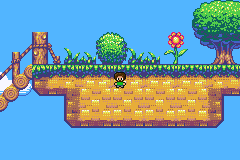
This demo embeds a 512x256 background image and a 16x16 character sprite, both as PNG files. The D-pad scrolls the background, and holding A + D-pad moves the sprite:
#include <gba/bios>
#include <gba/embed>
#include <gba/interrupt>
#include <gba/keyinput>
#include <gba/video>

#include <cstring>

constexpr auto bg = gba::embed::indexed4([] {
    return std::to_array<unsigned char>({
#embed "bg_2x1.png"
    });
});

constexpr auto hero = gba::embed::indexed4<gba::embed::dedup::none>([] {
    return std::to_array<unsigned char>({
#embed "sprite.png"
    });
});

int main() {
    gba::irq_handler = {};
    gba::reg_dispstat = {.enable_irq_vblank = true};
    gba::reg_ie = {.vblank = true};
    gba::reg_ime = true;

    gba::reg_dispcnt = {.video_mode = 0, .linear_obj_tilemap = true, .enable_bg0 = true, .enable_obj = true};
    gba::reg_bgcnt[0] = {.screenblock = 30, .size = 1}; // 512x256

    for (auto&& x : gba::obj_mem) {
        x = {.disable = true};
    }

    // Background palette + tiles
    std::memcpy(gba::memory_map(gba::pal_bg_mem), bg.palette.data(), sizeof(bg.palette));
    std::memcpy(gba::memory_map(gba::mem_tile_4bpp[0]), bg.sprite.data(), bg.sprite.size());

    // Background map: stored in screenblock order, memcpy directly
    std::memcpy(gba::memory_map(gba::mem_se[30]), bg.map.data(), sizeof(bg.map));

    // Sprite palette + tiles (no deduplication - sequential for 1D mapping)
    std::memcpy(gba::memory_map(gba::pal_obj_bank[0]), hero.palette.data(), sizeof(hero.palette));
    std::memcpy(gba::memory_map(gba::mem_vram_obj), hero.sprite.data(), hero.sprite.size());

    int scroll_x = 0, scroll_y = 0;
    int sprite_x = 112, sprite_y = 72;

    gba::object hero_obj = hero.sprite.obj();
    hero_obj.y = static_cast<unsigned short>(sprite_y & 0xFF);
    hero_obj.x = static_cast<unsigned short>(sprite_x & 0x1FF);
    gba::obj_mem[0] = hero_obj;

    gba::keypad keys;
    for (;;) {
        gba::VBlankIntrWait();
        keys = gba::reg_keyinput;

        if (keys.held(gba::key_a)) {
            // A + D-pad moves the sprite
            sprite_x += keys.xaxis();
            sprite_y += keys.i_yaxis();

            hero_obj.y = static_cast<unsigned short>(sprite_y & 0xFF);
            hero_obj.x = static_cast<unsigned short>(sprite_x & 0x1FF);
            gba::obj_mem[0] = hero_obj;
        } else {
            // D-pad scrolls the background
            scroll_x += keys.xaxis();
            scroll_y += keys.i_yaxis();

            gba::reg_bgofs[0][0] = static_cast<short>(scroll_x);
            gba::reg_bgofs[0][1] = static_cast<short>(scroll_y);
        }
    }
}
How it works
The background uses a 2x1 screenblock layout (size = 1 in reg_bgcnt), giving 64x32 tiles (512x256 pixels). The indexed4 map is stored in GBA screenblock order, so the entire map can be written to VRAM with one std::memcpy.
The sprite uses dedup::none so its tiles remain sequential - exactly what the GBA expects for 1D OBJ mapping. Without this, deduplication could merge mirrored tiles and break the sprite layout.
Transparent pixels (alpha < 128 in the PNG source) become palette index 0, so the hardware automatically shows the background through the sprite.
Tile deduplication
The indexed4 and indexed8 converters accept a dedup mode as a template parameter:
| Mode | Behaviour | Use case |
|---|---|---|
dedup::flip (default) | Matches identity, horizontal flip, vertical flip, and both | Background tilemaps |
dedup::identity | Matches exact duplicates only | Tilemaps without flip support |
dedup::none | No deduplication; tiles stay sequential | OBJ sprites |
using gba::embed::dedup;

constexpr auto bg = gba::embed::indexed4(supplier);
constexpr auto obj = gba::embed::indexed4<dedup::none>(supplier);
When dedup::flip is active, matching tiles reuse an existing tile index and encode flip flags in the emitted screen_entry. This keeps map VRAM usage low for symmetric art.
Sprite OAM helpers
When image dimensions match a valid GBA sprite size, indexed4 returns a sprite payload with obj() and obj_aff() helpers:
constexpr auto sprite = gba::embed::indexed4<gba::embed::dedup::none>([] {
    return std::to_array<unsigned char>({
#embed "sprite.png"
    });
});

gba::obj_mem[0] = sprite.sprite.obj(0);
gba::obj_aff_mem[0] = sprite.sprite.obj_aff(0);
Valid sprite sizes:
| Shape | Sizes |
|---|---|
| Square | 8x8, 16x16, 32x32, 64x64 |
| Wide | 16x8, 32x8, 32x16, 64x32 |
| Tall | 8x16, 8x32, 16x32, 32x64 |
If the source image does not match one of those shapes, obj() and obj_aff() fail at compile time.
Transparency and palettes
- PPM: palette index 0 is always reserved as transparent; the first visible colour becomes index 1.
- PNG: RGBA/GA alpha maps transparent pixels (alpha < 128) to palette index 0.
- TGA: 32bpp alpha and 16bpp attribute-bit transparency map transparent pixels (alpha < 128) to palette index 0.
- indexed4: images may spread across multiple palette banks when background tiles use <= 15 opaque colours per tile.
- indexed8: one 256-entry palette is shared across the whole image.
Constexpr evaluation limits
All image conversion happens at compile time. Large assets can hit GCC’s constexpr operation limit. If you see constexpr evaluation operation count exceeds limit, raise the limit for that target:
target_compile_options(my_target PRIVATE -fconstexpr-ops-limit=335544320)
Small sprites usually fit within default limits. Large backgrounds, especially 512x256 maps, often need a higher ceiling.