Multi-Player Link
The GBA Multi-Player serial mode connects two to four systems. Every transfer exchanges one 16-bit word with every connected system: player 0 is the parent that starts each transfer, and players 1 through 3 are children.
gba::link_multi builds a typed message stream over those transfers. A codec defines the value sent by the game, while
stdgba handles framing, escaping, integrity checks, player discovery, and buffering independently for every peer.
Creating the link
Define the codec at namespace scope, then use it as the first template argument. Capacity is the maximum framed
outgoing value and the pending wire-data capacity for each peer.
#include <gba/codec>
#include <gba/link>

constexpr auto message_codec = gba::codec::uint8_codec;
constexpr std::size_t link_capacity = 32;

using link_type = gba::link_multi<message_codec, link_capacity>;
auto& link = gba::link.emplace<link_type>(gba::sio_baud_115200);
gba::link represents the GBA’s single serial port. emplace replaces the active link, constructs the new type
directly in static storage, and returns a typed reference to it.
All connected systems must use the same codec and baud rate. Available Multi-Player baud rates are gba::sio_baud_9600,
gba::sio_baud_38400, gba::sio_baud_57600, and gba::sio_baud_115200.
Interrupt and polling contract
Enable the serial interrupt and forward it to link.irq():
gba::irq_handler = [&link](const gba::irq flags) {
    if (flags.serial) {
        link.irq();
    }
};
gba::reg_ie = {.serial = true};
gba::reg_ime = true;
The IRQ handler only captures the completed hardware transfer and stages the next word. Call poll() continuously from
your main loop to process completed transfers, update the topology, dispatch errors, and start new rounds:
for (;;) {
    link.poll();

    // Update the game and render when needed.
}
Do not limit poll() to once per video frame. Link throughput and message latency depend on how frequently it runs.
Sending and receiving
send() begins sending one encoded value to every connected peer. It returns false if another value is still in
flight or if the framed value exceeds Capacity.
if (!link.sending()) {
    link.send(local_state);
}
Each remote player has an independent receive stream:
const auto local_player = link.player();
for (const auto player : gba::multi_players) {
    if (player == local_player) {
        continue;
    }

    while (auto incoming = link.read(player)) {
        apply_remote_state(gba::multi_player_index(player), *incoming);
    }
}
player() returns the local gba::multi_player identifier, is_parent() identifies player 0, and connected() returns the current
four-player connection mask. A newly configured link initially reports no connected players; topology is learned as
transfer rounds complete.
Demo: Four-player movement
The demo serialises one player value containing position, facing direction, and animation frame. Each GBA controls its
own character and renders the latest state received from every connected peer.
#include <gba/bios>
#include <gba/codec>
#include <gba/embed>
#include <gba/interrupt>
#include <gba/keyinput>
#include <gba/link>
#include <gba/memory>
#include <gba/peripherals>
#include <gba/video>

#include <algorithm>
#include <array>
#include <cstddef>
#include <cstring>

namespace codec = gba::codec;

constexpr auto p1_sheet = gba::embed::indexed4_sheet<16, 16>([] {
    return std::to_array<unsigned char>({
#embed "link_multiplay_p1.png"

    });
});
constexpr auto p2_sheet = gba::embed::indexed4_sheet<16, 16>([] {
    return std::to_array<unsigned char>({
#embed "link_multiplay_p2.png"

    });
});
constexpr auto p3_sheet = gba::embed::indexed4_sheet<16, 16>([] {
    return std::to_array<unsigned char>({
#embed "link_multiplay_p3.png"

    });
});
constexpr auto p4_sheet = gba::embed::indexed4_sheet<16, 16>([] {
    return std::to_array<unsigned char>({
#embed "link_multiplay_p4.png"

    });
});
using sheet_type = decltype(p1_sheet);

constexpr std::size_t link_capacity = 16; // Reserve enough wire storage for one framed player update

enum facing : unsigned char {
    facing_down = 0,
    facing_right = 1,
    facing_up = 2,
    facing_left = 3
};

struct player {
    unsigned char x = 0;
    unsigned char y = 0;
    unsigned char dir = facing_down;
    unsigned char anim = 0;
    gba::object obj{};

    constexpr player() = default;
    constexpr player(unsigned char x, unsigned char y, unsigned char dir, unsigned char anim);
    constexpr player(unsigned char x, unsigned char y, gba::object obj);

    static constexpr auto codec = codec::make_tuple_codec(codec::member<&player::x>(codec::uint8_codec),
                                                          codec::member<&player::y>(codec::uint8_codec),
                                                          codec::member<&player::dir>(codec::uint8_codec),
                                                          codec::member<&player::anim>(codec::uint8_codec))
                                      .apply<player>();

    void move(int dx, int dy, unsigned int frame);
    void apply(const player& state);
    const gba::object& draw(const gba::object& base, bool visible);
};

std::array<player, 4> make_players(const std::array<gba::object, 4>& objects);

int main() {
    gba::bitpool objVram{gba::memory_map(gba::mem_vram_obj), 1024};
    const auto upload = [&objVram](const auto& sheet, const unsigned short palIdx) {
        std::memcpy(gba::memory_map(gba::pal_obj_bank[palIdx]), sheet.palette.data(), sizeof(sheet.palette));
        void* dest = objVram.allocate(sheet.sprite.size());
        std::memcpy(dest, sheet.sprite.data(), sheet.sprite.size());
        return sheet.frame_obj(gba::tile_index(dest), 0, palIdx);
    };
    const std::array baseObj{
        upload(p1_sheet, 0),
        upload(p2_sheet, 1),
        upload(p3_sheet, 2),
        upload(p4_sheet, 3),
    };

    // Configure the serial port for typed four-player communication
    auto& link = gba::link.emplace<gba::link_multi<player::codec, link_capacity>>(gba::sio_baud_115200);

    std::ranges::fill(gba::obj_mem, gba::object{.disable = true});
    gba::reg_dispcnt = {.linear_obj_tilemap = true, .enable_obj = true};
    gba::irq_handler = [&link](const gba::irq flags) {
        if (flags.serial) {
            link.irq(); // Capture the completed transfer and stage the next link word
        }
    };
    gba::reg_dispstat = {.enable_irq_vblank = true};
    gba::reg_ie = {.vblank = true, .serial = true}; // Enable the serial link interrupt
    gba::reg_ime = true;

    // Wait until at least one remote player joins the link
    while (link.connected_count() < 2) {
        link.poll(); // Process link transfers and start the next multiplayer round
    }
    const auto myPlayer = link.player();

    auto players = make_players(baseObj);

    unsigned int frame = 0;
    gba::keypad keys;

    while (true) {
        ++frame;

        keys = gba::reg_keyinput;
        const int dx = keys.xaxis();
        const int dy = keys.i_yaxis();
        players[gba::multi_player_index(myPlayer)].move(dx, dy, frame);

        // Do not replace a player update that is still being transmitted
        if (!link.sending()) {
            link.send(players[gba::multi_player_index(myPlayer)]); // Encode and queue the local player's latest state
        }

        // Check each possible remote player's independent receive stream
        for (const auto player : gba::multi_players) {
            if (player == myPlayer) {
                continue; // The local state is authoritative and never arrives over the link
            }
            // Drain all complete updates received from this remote player
            while (auto incoming = link.read(player)) {
                players[gba::multi_player_index(player)].apply(*incoming);
            }
        }

        while (gba::reg_vcount < 159) {
            link.poll(); // Keep the link moving while waiting for the safe OAM update period
        }

        gba::VBlankIntrWait();

        // Snapshot which player slots currently have a connected system
        const auto connected = link.connected();
        for (std::size_t id = 0; id < 4; ++id) {
            // Hide remote sprites whose systems are not connected
            gba::obj_mem[id] =
                players[id].draw(baseObj[id], id == gba::multi_player_index(myPlayer) || connected[id]);
        }

        while (gba::reg_vcount >= 160) {
            link.poll(); // Continue servicing the link throughout the remainder of VBlank
        }
    }
}

constexpr int max_x = 240 - sheet_type::frame_width;
constexpr int max_y = 160 - sheet_type::frame_height;
constexpr int spawn_inset = 40;
constexpr std::array walk_table{0, 1, 0, 2};

constexpr int clampi(const int value, const int low, const int high) noexcept {
    return value < low ? low : (value > high ? high : value);
}

constexpr player::player(const unsigned char x, const unsigned char y, const unsigned char dir,
                         const unsigned char anim)
    : x(x), y(y), dir(dir), anim(anim) {}

constexpr player::player(const unsigned char x, const unsigned char y, const gba::object obj) : x(x), y(y), obj(obj) {}

void player::move(const int dx, const int dy, const unsigned int frame) {
    if (dx != 0) {
        dir = dx > 0 ? facing_right : facing_left;
    } else if (dy != 0) {
        dir = dy > 0 ? facing_down : facing_up;
    }
    x = static_cast<unsigned char>(clampi(x + dx, 0, max_x));
    y = static_cast<unsigned char>(clampi(y + dy, 0, max_y));
    anim = dx != 0 || dy != 0 ? walk_table[(frame / 10) % 4] : 0;
}

void player::apply(const player& state) {
    x = state.x;
    y = state.y;
    dir = state.dir;
    anim = state.anim;
}

const gba::object& player::draw(const gba::object& base, const bool visible) {
    obj.disable = !visible;
    if (visible) {
        const unsigned int frame = static_cast<unsigned int>(dir) * sheet_type::columns + anim;
        obj.tile_index = base.tile_index + sheet_type::tile_offset(frame);
        obj.x = static_cast<unsigned short>(x);
        obj.y = static_cast<unsigned short>(y);
    }
    return obj;
}

std::array<player, 4> make_players(const std::array<gba::object, 4>& objects) {
    constexpr std::array spawn_positions{
        std::array{        spawn_inset,         spawn_inset},
        std::array{max_x - spawn_inset,         spawn_inset},
        std::array{        spawn_inset, max_y - spawn_inset},
        std::array{max_x - spawn_inset, max_y - spawn_inset},
    };

    return {
        player{spawn_positions[0][0], spawn_positions[0][1], objects[0]},
        player{spawn_positions[1][0], spawn_positions[1][1], objects[1]},
        player{spawn_positions[2][0], spawn_positions[2][1], objects[2]},
        player{spawn_positions[3][0], spawn_positions[3][1], objects[3]},
    };
}
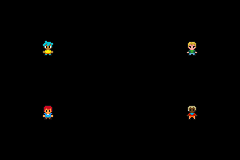
The demo polls throughout active display and the remainder of VBlank, but writes OAM only immediately after
VBlankIntrWait().
Errors and topology changes
Errors are sticky until explicitly cleared. Query one peer with errors(player) or has_error(player, error), and
clear them with clear_error() or clear_errors().
link.on_error([](const std::size_t player, const gba::link_error error) {
    handle_link_error(player, error);
});
The callback runs from poll(), never from interrupt context. gba::link_error::topology_changed is reported when a
remote player connects, disconnects, or the local player changes. Other errors distinguish receive overflow,
malformed framing, integrity failure, codec failure, and hardware failure.