Timers
The GBA has four hardware timers (0-3). Each is a 16-bit counter that increments at a configurable rate and can trigger an interrupt on overflow. Timers can cascade - timer N+1 increments when timer N overflows - enabling periods far longer than a single 16-bit counter allows.
Compile-time timer configuration
stdgba configures timers at compile time using std::chrono durations. The compiler selects the best prescaler and cascade chain automatically:
#include <gba/timer>
#include <gba/peripherals>
#include <algorithm>

using namespace std::chrono_literals;

// A 1-second timer with overflow IRQ
constexpr auto timer_1s = gba::compile_timer(1s, true);

// Write the cascade chain to hardware starting at timer 0
std::copy(timer_1s.begin(), timer_1s.end(), gba::reg_tmcnt.begin());
compile_timer returns a std::array of timer register values. A simple duration might need only one timer; a long duration might cascade two or three. The array size is determined at compile time.
You can also start timers at a specific index:
// Use timers 2 and 3 for a long-duration timer
constexpr auto timer_10s = gba::compile_timer(10s, false);  // No IRQ
std::copy(timer_10s.begin(), timer_10s.end(), gba::reg_tmcnt.begin() + 2);
And disable timers by clearing their control registers:
// Disable timer 0
gba::reg_tmcnt_h[0] = {};
Supported durations
Any std::chrono::duration works:
#include <gba/timer>
#include <gba/peripherals>
#include <algorithm>

using namespace std::chrono_literals;

constexpr auto fast = gba::compile_timer(16ms);
constexpr auto slow = gba::compile_timer(30s, true);
constexpr auto precise = gba::compile_timer(100us);

// All three can be loaded without conflicts (each uses different timer indices)
std::copy(fast.begin(), fast.end(), gba::reg_tmcnt.begin() + 0);    // Timers 0+
std::copy(slow.begin(), slow.end(), gba::reg_tmcnt.begin() + 1);    // Timers 1+
std::copy(precise.begin(), precise.end(), gba::reg_tmcnt.begin() + 2);  // Timers 2+
If the duration cannot be represented exactly, compile_timer picks the closest possible configuration. Use compile_timer_exact if you need an exact match (compile error if impossible).
Raw timer registers
For manual control, write directly to the timer registers:
#include <gba/peripherals>

// Timer 0: 1024-cycle prescaler, enable interrupt
gba::reg_tmcnt_l[0] = 0;                                      // Reload value (auto-reload on overflow)
gba::reg_tmcnt_h[0] = {
    .cycles = gba::cycles_1024,
    .overflow_irq = true,
    .enabled = true
};

// Timer 1: cascade from timer 0 (counts overflows)
gba::reg_tmcnt_l[1] = 0;
gba::reg_tmcnt_h[1] = {
    .cascade = true,
    .overflow_irq = true,
    .enabled = true
};
Polling timer state
Read the current timer counter (careful: this captures the live counter value):
// Get current count of timer 0
unsigned short count = gba::reg_tmcnt_l_stat[0];

// Check if timer 2 is running
bool timer2_enabled = (gba::reg_tmcnt_h[2].enabled);
Note: reg_tmcnt_l_stat is a read-only view of the counter registers. The count continuously increments and should be read only when you need the current value.
Prescaler values
| Value | Divider | Frequency |
|---|---|---|
| 0 | 1 | 16.78 MHz |
| 1 | 64 | 262.2 kHz |
| 2 | 256 | 65.5 kHz |
| 3 | 1024 | 16.4 kHz |
tonclib comparison
| stdgba | tonclib |
|---|---|
compile_timer(1s) | Manual prescaler + reload calculation |
gba::reg_tmcnt_h[0] = { ... }; | REG_TM0CNT = TM_FREQ_1024 | TM_ENABLE; |
| Automatic cascade chain | Manual multi-timer setup |
Demo: Analogue Clock with Timer
This demo combines compile-time timer setup, timer IRQ handling, shapes-generated OBJ sprites, and BIOS affine transforms for clock-hand rotation:
#include <gba/angle>
#include <gba/bios>
#include <gba/color>
#include <gba/interrupt>
#include <gba/peripherals>
#include <gba/shapes>
#include <gba/timer>
#include <gba/video>

#include <array>
#include <cstdint>
#include <cstring>

using namespace std::chrono_literals;
using namespace gba::shapes;
using namespace gba::literals;
using namespace gba;

namespace {

    constexpr auto second_timer = compile_timer(1s, true);
    static_assert(second_timer.size() == 1);

    constexpr int clock_center_x = 120;
    constexpr int clock_center_y = 80;
    constexpr int sprite_half_extent = 32;

    // Clock face: visible outline, hour markers, and center hub.
    constexpr auto clock_face = sprite_64x64(palette_idx(1), circle_outline(32.0, 32.0, 30.0, 2), palette_idx(1),
                                             rect(31, 4, 2, 6), palette_idx(1), rect(31, 54, 2, 6), palette_idx(1),
                                             rect(4, 31, 6, 2), palette_idx(1), rect(54, 31, 6, 2), palette_idx(1),
                                             circle(32.0, 32.0, 2.5));

    // Hands are authored pointing straight up.
    // ObjAffineSet rotates visually anti-clockwise for positive angles, so the
    // runtime clock update negates angles to get normal clockwise clock motion.
    constexpr auto hand_hour = sprite_64x64(palette_idx(3), rect(30, 18, 4, 15));

    constexpr auto hand_minute = sprite_64x64(palette_idx(3), rect(31, 12, 2, 21));

    constexpr auto hand_second = sprite_64x64(palette_idx(2), rect(31, 8, 2, 25));

} // namespace

int main() {
    // Set up IRQ.
    std::uint32_t elapsed_seconds = 0;
    irq_handler = {[&elapsed_seconds](irq flags) {
        if (flags.timer2) {
            elapsed_seconds += 1;
        }
    }};
    reg_dispstat = {.enable_irq_vblank = true};
    reg_ie = {.vblank = true, .timer2 = true};
    reg_ime = true;

    // Start a 1-second timer on timer 2.
    reg_tmcnt[2] = second_timer[0];

    // Set up video mode 0 with sprites.
    reg_dispcnt = {
        .video_mode = 0,
        .linear_obj_tilemap = true,
        .enable_obj = true,
    };

    // Bank 0, colour 0 stays transparent for all sprites.
    pal_obj_bank[0][0] = "black"_clr;
    pal_obj_bank[0][1] = "firebrick"_clr;
    pal_obj_bank[0][2] = "lime"_clr;
    pal_obj_bank[0][3] = "royalblue"_clr;

    // Copy sprite data to OBJ VRAM using byte offsets.
    auto* objVram = reinterpret_cast<std::uint8_t*>(memory_map(mem_vram_obj));
    const auto baseTileIndex = tile_index(memory_map(mem_vram_obj));
    std::uint16_t vramOffset = 0;

    std::memcpy(objVram + vramOffset, clock_face.data(), clock_face.size());
    const auto tileIdxFace = static_cast<unsigned short>(baseTileIndex + vramOffset / sizeof(tile4bpp));
    vramOffset += static_cast<std::uint16_t>(clock_face.size());

    std::memcpy(objVram + vramOffset, hand_hour.data(), hand_hour.size());
    const auto tileIdxHour = static_cast<unsigned short>(baseTileIndex + vramOffset / sizeof(tile4bpp));
    vramOffset += static_cast<std::uint16_t>(hand_hour.size());

    std::memcpy(objVram + vramOffset, hand_minute.data(), hand_minute.size());
    const auto tileIdxMinute = static_cast<unsigned short>(baseTileIndex + vramOffset / sizeof(tile4bpp));
    vramOffset += static_cast<std::uint16_t>(hand_minute.size());

    std::memcpy(objVram + vramOffset, hand_second.data(), hand_second.size());
    const auto tileIdxSecond = static_cast<unsigned short>(baseTileIndex + vramOffset / sizeof(tile4bpp));

    auto faceObj = clock_face.obj(tileIdxFace);
    faceObj.x = clock_center_x - sprite_half_extent;
    faceObj.y = clock_center_y - sprite_half_extent;
    obj_mem[0] = faceObj;

    auto hourObj = hand_hour.obj_aff(tileIdxHour);
    hourObj.x = clock_center_x - sprite_half_extent;
    hourObj.y = clock_center_y - sprite_half_extent;
    hourObj.affine_index = 0;
    obj_aff_mem[1] = hourObj;

    auto minuteObj = hand_minute.obj_aff(tileIdxMinute);
    minuteObj.x = clock_center_x - sprite_half_extent;
    minuteObj.y = clock_center_y - sprite_half_extent;
    minuteObj.affine_index = 1;
    obj_aff_mem[2] = minuteObj;

    auto secondObj = hand_second.obj_aff(tileIdxSecond);
    secondObj.x = clock_center_x - sprite_half_extent;
    secondObj.y = clock_center_y - sprite_half_extent;
    secondObj.affine_index = 2;
    obj_aff_mem[3] = secondObj;

    // Disable remaining OAM entries.
    for (int i = 4; i < 128; ++i) {
        obj_mem[i] = {.disable = true};
    }

    std::array<object_parameters, 3> affineParams{
        {
         {.sx = 1.0_fx, .sy = 1.0_fx, .alpha = 0_deg},
         {.sx = 1.0_fx, .sy = 1.0_fx, .alpha = 0_deg},
         {.sx = 1.0_fx, .sy = 1.0_fx, .alpha = 0_deg},
         }
    };

    ObjAffineSet(affineParams.data(), memory_map(mem_obj_aff), affineParams.size(), 8);

    while (true) {
        VBlankIntrWait();

        const std::uint32_t secs = elapsed_seconds;
        const auto hours = static_cast<unsigned int>((secs / 3600U) % 12U);
        const auto mins = static_cast<unsigned int>((secs / 60U) % 60U);
        const auto secUnits = static_cast<unsigned int>(secs % 60U);

        affineParams[0].alpha = -(30_deg * hours + 0.5_deg * mins);
        affineParams[1].alpha = -(6_deg * mins + 0.1_deg * secUnits);
        affineParams[2].alpha = -(6_deg * secUnits);

        ObjAffineSet(affineParams.data(), memory_map(mem_obj_aff), affineParams.size(), 8);
    }
}
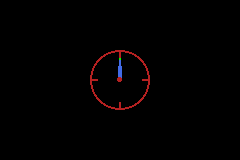
Key points shown in the demo:
compile_timer(1s, true)configures a 1-second overflow interrupt at compile time.- The timer IRQ increments a seconds counter used for hand angles.
ObjAffineSet(...)writes affine matrices each frame to rotate hour/minute/second hands.- Angle literals are used directly in runtime math (
30_deg * hours + 0.5_deg * mins).